See the conditions people experience inside the building.
LEXI combines indoor air quality, temperature, humidity and other supported environmental data into one connected operating view.
Identify spaces that need attention, give operators better context and connect environmental conditions to the systems that can affect them.
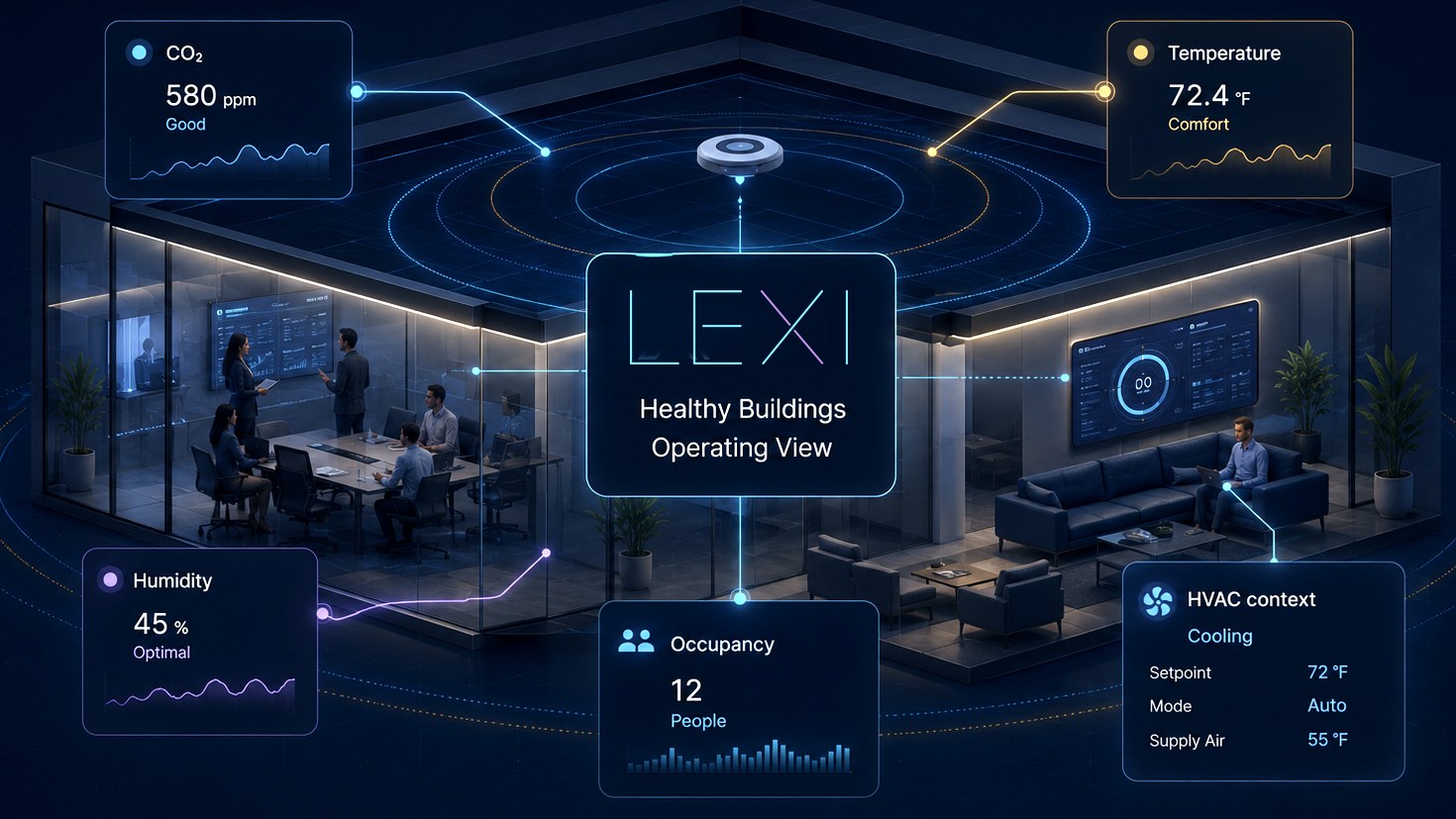
Move from isolated sensor readings to actionable building context.
LEXI connects supported environmental sensors and building-system data so teams can understand what is happening, where it is happening and what operating conditions may be contributing.
Measure
Monitor supported CO2, temperature, humidity, particulate, VOC and related environmental measurements.
Contextualize
Associate conditions with buildings, floors, rooms, zones, occupancy and equipment state.
Alert
Notify operators when configured environmental conditions move outside defined ranges.
Improve
Use the same context to support ventilation, HVAC, comfort and facility workflows where authorized.
Monitor the environmental conditions that affect comfort and indoor quality.
LEXI brings supported room and zone sensors into one operating layer so teams can see current conditions, trends and configured exceptions.
CO2 monitoring
Track supported CO2 measurements by room, zone and building to understand ventilation-related conditions.
Temperature & humidity
Monitor thermal and moisture conditions that influence comfort and building operation.
Particulates & VOCs
Connect supported PM and VOC sensors where these measurements are part of the deployment.
Trend visibility
Review current and historical environmental data to identify recurring or persistent conditions.
Threshold alerts
Route configured notifications when supported measurements move outside customer-defined ranges.
Environmental data is more useful when it is connected to building operation.
LEXI combines environmental measurements with occupancy and HVAC context so operators can distinguish isolated readings from broader operating conditions.
Occupancy context
Use actual occupancy to understand whether an environmental condition is occurring in an occupied space.
HVAC operating state
Relate room conditions to available HVAC status, schedules and supported control points.
Comfort visibility
Compare temperature and humidity conditions across rooms, zones and time periods.
Ventilation support
Use supported CO2, occupancy and HVAC data to inform ventilation-related operating decisions.
Any control action is executed only through supported, authorized LEXI workflows.
Use indoor-environment data beyond the dashboard.
The same environmental data can support facility response, portfolio comparison and selected healthy-building or sustainability workflows.
Facility response
Route environmental exceptions to the appropriate building, engineering or facility team.
Portfolio visibility
Compare selected environmental conditions across rooms, buildings and properties using a consistent location hierarchy.
Healthy-building reporting support
Use selected measured environmental data in customer-defined healthy-building and indoor-environment reporting workflows.
WELL / building-performance support Roadmap
Future support for organizing selected operational data used in healthy-building and building-performance frameworks.
LEXI provides sensing, operational context and reporting support; it does not itself provide health determinations, regulatory compliance determinations or certification.
Reuse the same environmental context wherever indoor conditions matter.
Connected environmental data can strengthen energy, occupancy, hospitality, equipment and reporting workflows without adding another data silo.
Occupancy & People Counting
Combine environmental conditions with actual space use to understand which occupied areas need attention.
Energy, HVAC & Lighting
Use environmental and occupancy context to support comfort, ventilation and selected HVAC strategies.
Smart Room / Hospitality Operations
Use room-level environmental data to support guest comfort and hotel operating workflows.
Building Operations & Equipment
Relate room conditions to equipment state and diagnostics when investigating building-performance issues.
Sustainability & Reporting
Reuse approved environmental measurements in selected portfolio and reporting workflows.
Begin with IAQ, comfort or environmental visibility.
Start with the spaces or conditions that generate the most complaints, uncertainty or operating risk, then extend sensing and workflows on the same connected edge.
Indoor air quality
Monitor CO2, particulate, VOC and related measurements using supported sensors.
Comfort & thermal conditions
Track temperature and humidity by room, zone and property.
Environmental operations
Connect alerts and conditions to occupancy, HVAC state and facility response workflows.
Start with the indoor condition you need to understand.
Measure the first problem clearly, then reuse the same connected edge across more spaces, conditions and operating workflows.