Put AI where buildings actually operate.
LEXI distributes intelligence across the building edge, site and cloud so AI can work with real equipment, sensor and occupancy data in the context where decisions are made.
Edge intelligence reduces latency and preserves local operation, while LEXI's governed architecture keeps physical control inside authorized deterministic services.
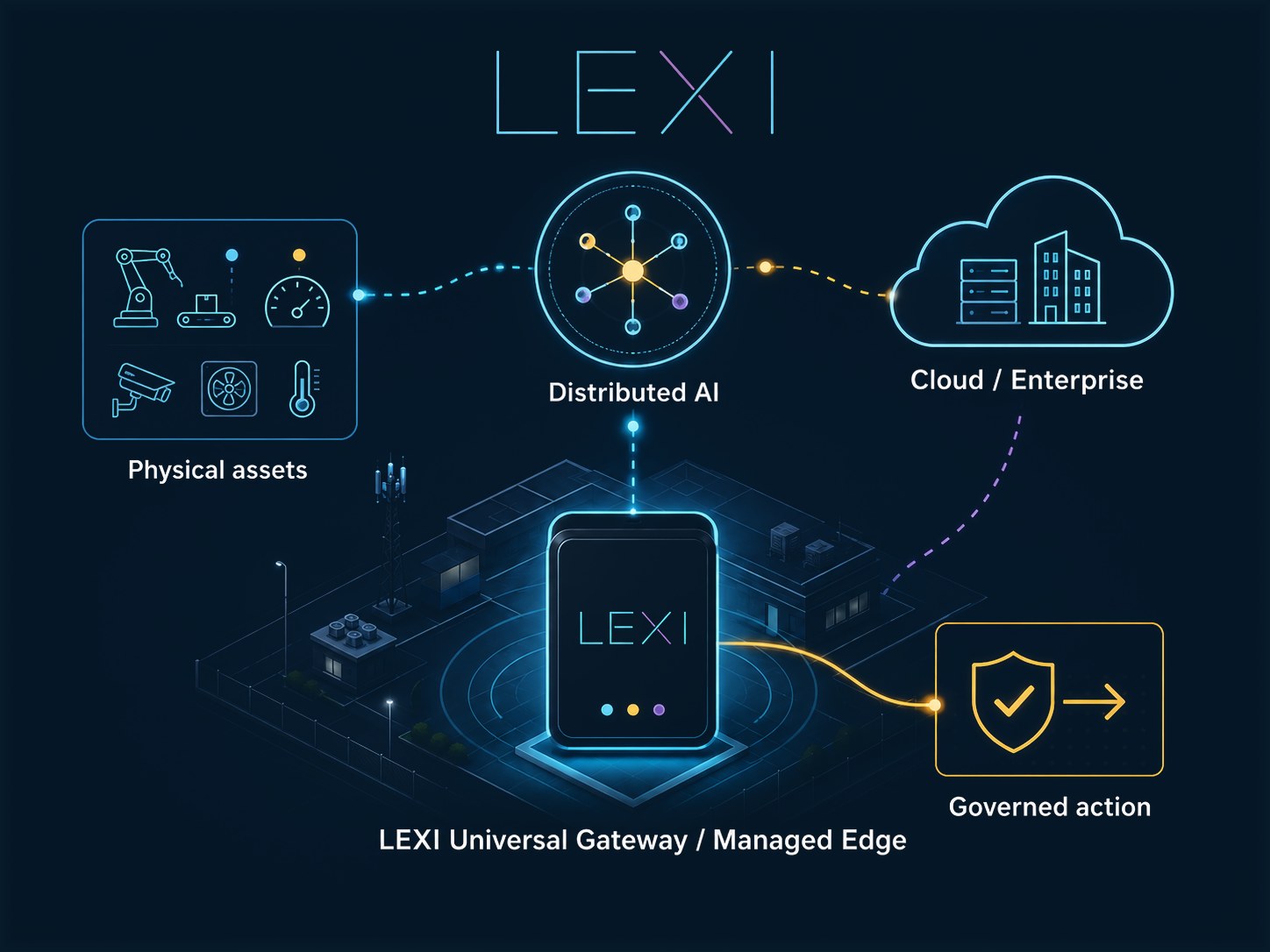
Connect AI to the physical building through a governed control loop.
LEXI turns fragmented device and equipment data into usable building context, applies rules or intelligence at the right layer, and keeps physical actions inside authorized workflows.
Sense
Collect supported sensor, meter, occupancy, equipment and environmental data across multiple protocols.
Context
Normalize data by building, floor, room, zone and asset so intelligence understands what each signal represents.
Reason
Apply rules, thresholds and supported AI/ML models to identify conditions, patterns and likely outcomes.
Act
Send approved recommendations or commands through LEXI's governed control services.
Verify
Confirm device and equipment response using available status and telemetry.
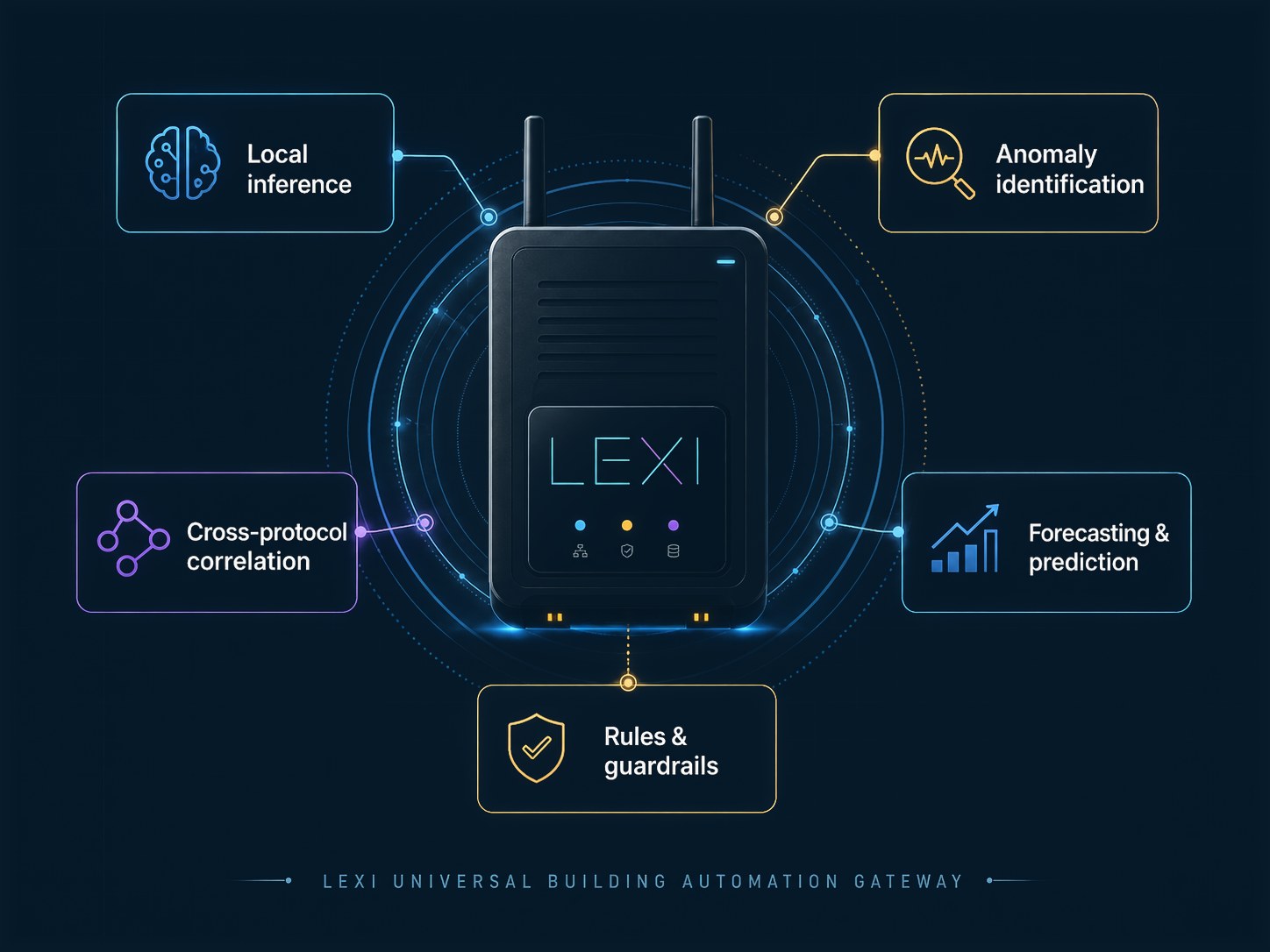
Run lightweight intelligence directly on the building edge.
LEXI is using the NXP eIQ AI development environment on the Universal Building Automation Gateway to deploy and evaluate lightweight AI/ML models close to connected equipment and sensors.
Local inference
Evaluate supported models at the gateway without sending every decision round-trip to the cloud.
Anomaly identification
Use local data patterns and context to help identify unusual operating conditions.
Cross-protocol correlation
Combine data from previously separate systems so intelligence can reason across more of the building.
Forecasting & prediction
Support selected predictive models where local building data and model requirements are appropriate.
Rules & guardrails
Pair model outputs with deterministic thresholds, permissions and operating constraints.
Coordinate intelligence across gateways, buildings and cloud services.
Distributed AI does not force every workload into one compute layer. LEXI places sensing, context, inference and centralized services according to latency, resilience and operational needs.
Gateway intelligence
Handle time-sensitive sensing, local inference, rules and selected orchestration close to equipment.
Building / site intelligence
Combine context from multiple systems and gateways to support site-level operating decisions.
Cloud intelligence
Use centralized services for portfolio analytics, model management, historical analysis and enterprise integration.
Offline continuity
Keep supported local monitoring, rules and workflows operating when upstream connectivity is unavailable.
Managed deployment
Use managed-edge services for secure provisioning, software updates, device health and controlled workload deployment.
Separate probabilistic intelligence from physical write authority.
LEXI is designed so AI outputs can inform building operation without becoming unrestricted commands to physical equipment.
Permission boundaries
Limit physical write authority to approved services, devices, zones and workflows.
Operating constraints
Apply thresholds, schedules, setpoint limits and other deterministic guardrails before supported actions execute.
Protected workflows
Route actions through controlled services rather than giving an AI model direct device-level access.
Verification
Use available telemetry and command/status feedback to confirm that physical systems responded as expected.
Resilience
Preserve supported local operation and control boundaries during connectivity or service disruptions.
Apply local intelligence to operating problems that benefit from building context.
Current model-development and evaluation targets on the LEXI Universal Building Automation Gateway span energy, equipment and presence-related use cases.
Energy consumption prediction
Use connected building data to evaluate models that estimate near-term energy consumption.
Energy demand forecasting
Evaluate local demand patterns to support more informed building-energy decisions.
Equipment remaining useful life
Explore model-based estimates of equipment condition and remaining useful life where sufficient telemetry exists.
Presence sensing
Use supported sensor inputs and local intelligence to improve understanding of space presence.
Location & tracking
Evaluate supported location and tracking models for selected building and asset contexts.
Battery charging / discharging prediction
Evaluate selected energy-storage prediction models where appropriate data and equipment are available.
Choose the AI problem where latency, resilience or local context matters most.
Start with a defined building outcome and the data needed to support it, then expand distributed intelligence across the same connected edge as models and operating requirements mature.
Connect the context
Bring the required sensors, equipment and operating data into the LEXI edge.
Deploy the intelligence
Apply supported rules or lightweight models close to the physical systems.
Govern the action
Keep model recommendations and physical controls inside defined permissions and operating limits.
Distributed AI | Local inference | Cross-protocol context | Anomaly identification | Forecasting | Governed control | Offline continuity | Managed deployment